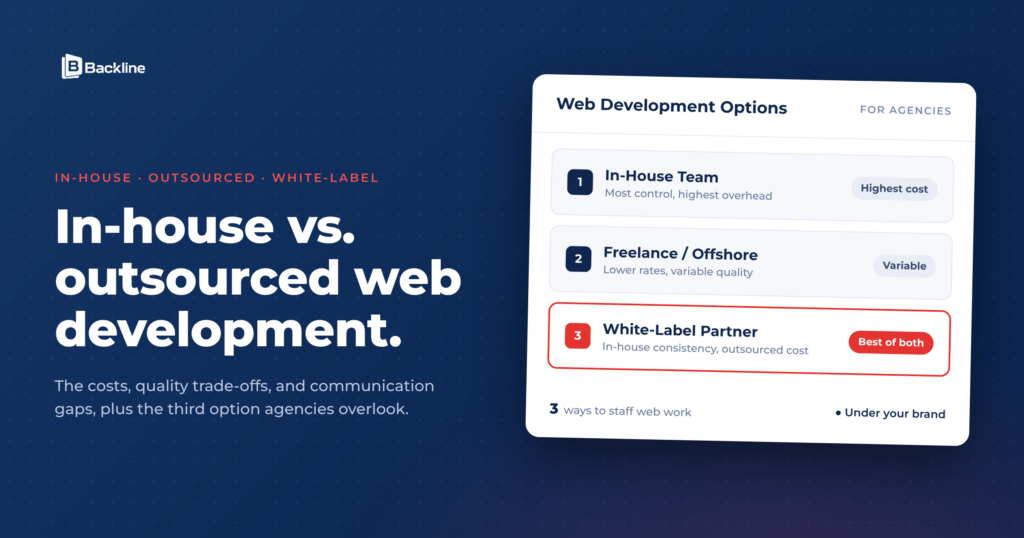
If you’re a marketing agency offering website building, you’ve probably volleyed between in-house or outsourced web development.
Maybe you’re maintaining an in-house team but considering the cost-saving trade-offs of moving to an offshore model. Or maybe your go-to freelance developer just shipped their last project, leaving you in the market for a more reliable option.
In the precarious dance of agency web development, we’re sharing our accumulated knowledge: the pros, cons, and alternatives of in-house vs. outsourced web development, so you can make the best decision for your agency.
In-House
If you’re a full-service or larger agency that wants more control and consistency in your website projects, in-house is probably for you. Smaller and specialized agencies can certainly go this route too—but it’ll cost you.
Costs
Cost is the heaviest factor when weighing in-house vs. outsourced web development. It costs an agency substantially more to retain an in-house team of developers and designers than it does to outsource the work.
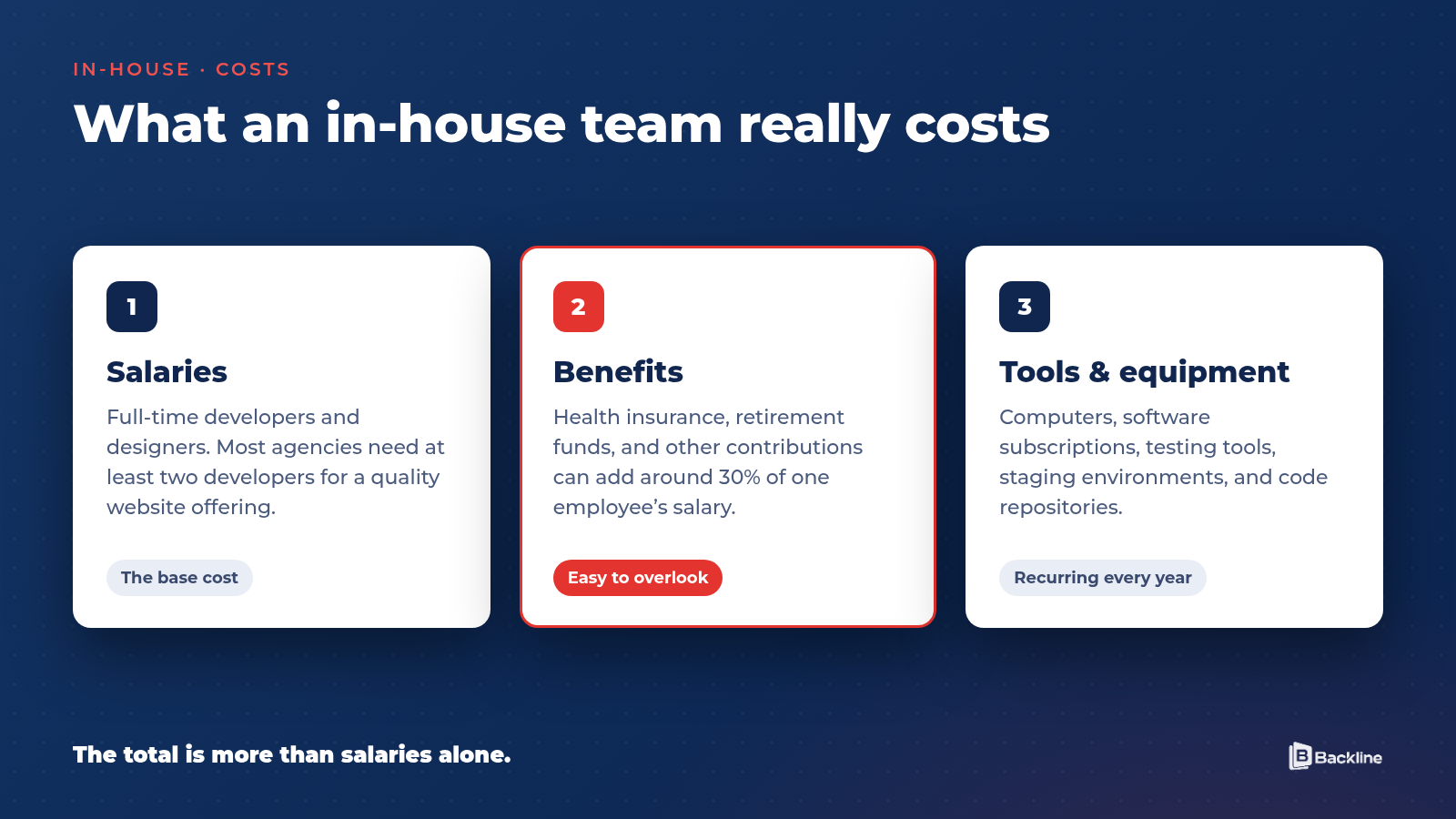
The median salary for a full-time web developer in 2026 is $92,650, and $70,000 for a designer. That doesn’t include the costs of health insurance, retirement funds, and other contributions, which can add around 30% of one employee’s salary. While smaller boutique agencies might get away with employing just one or two developers, most need at least two to fulfill a quality website offering.
In-house costs also include tools and equipment. In-house employees will need a computer, software subscriptions, testing tools, staging environments, and code repositories. Depending on your tech stack, this can range from a couple thousand to several thousands of dollars per year.
Work Quality
With an in-house team, you’re paying for more control of the work quality—and that’s one of the biggest benefits of going this route. As an agency leader, in-house gives you more oversight of projects and easier communication with the team doing the work. There’s also the benefit of repetition. An in-house team gets familiar with the agency’s proprietary methods and can even complete brand-specific training to build predictability and consistency that you can scale.
Communication
One of the most important reasons many agencies choose in-house development is the promise of better communication. An in-house developer works the same or similar schedule as the rest of the team, meaning they’re accessible in real time on Slack or a project management tool for answering questions, solving problems, and collaborating. That means faster answers to questions and invaluable control over development as a whole.
It’s also helpful to have an in-house developer who can, or is willing to, communicate directly with clients. Some agencies pay developers to hop on sales or kick-off calls to talk through the complexities of custom plugins, integrations, Advanced Custom Fields, or other technical solutions to build trust with the client and demonstrate expertise.
Outsourced
The most common outsourced developers are freelance or offshore. This option is nice for agencies that might have fewer web development projects or want to save on cost—with the trade-off being more variable service, quality, and communication.
Costs
The cost to outsource web development is usually less than in-house. The per-hour fee for a freelancer or offshore developer can range between $20 and $60 or more, depending on their experience and specialty. Total hours per project can also vary largely, but can average from 60, for simpler builds, to 200+, for more complex ones.
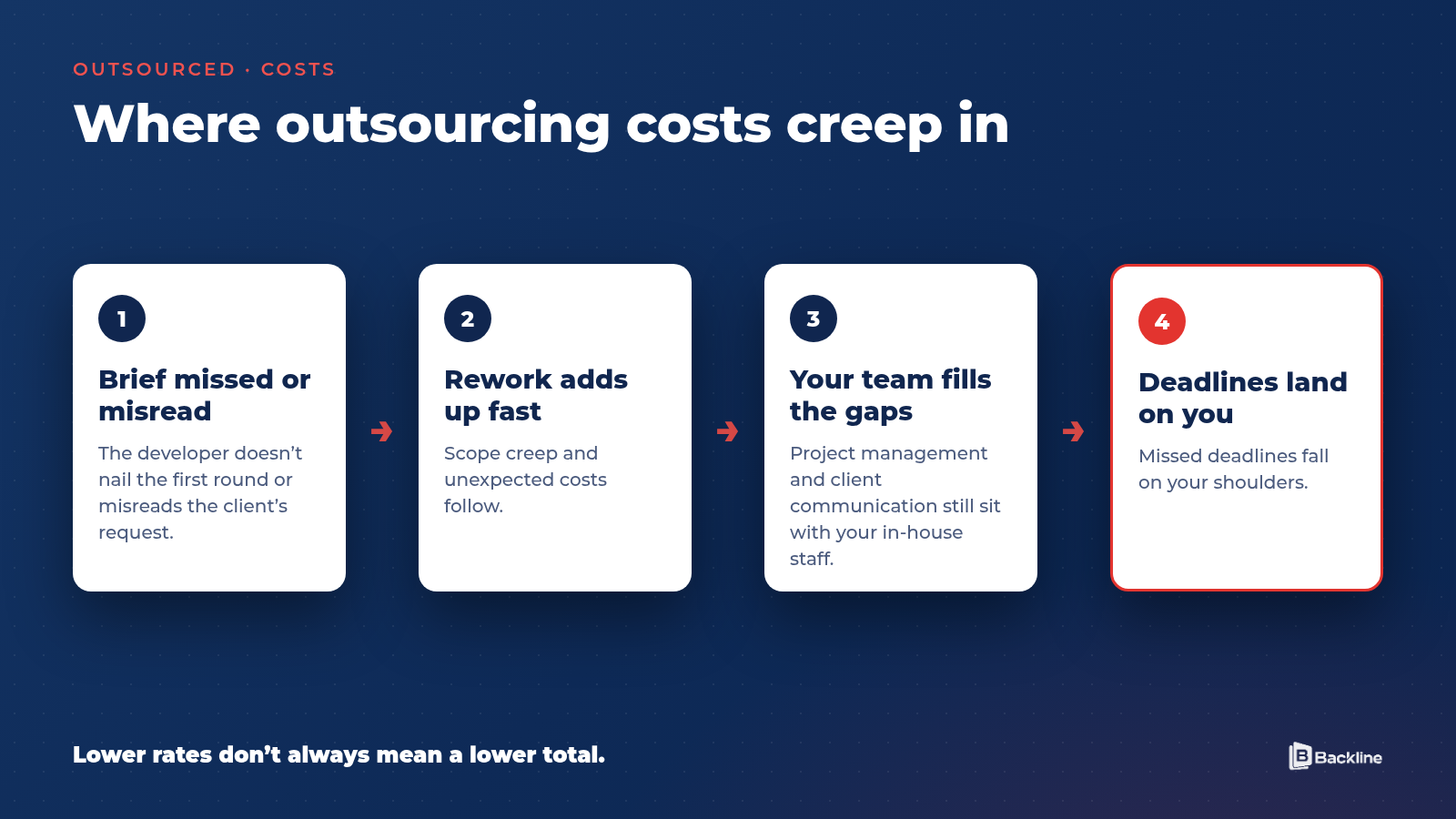
The variability of outsourcing can lead to scope creep and unexpected costs. For one, outsourcing web development still leaves other project tasks, like project management and client-communication, on the plates of your in-house staff. Additionally, if the developer doesn’t nail the brief on the first round or misinterprets the clients’ requests, rework can add up fast.
Work Quality
Compared to in-house, the work quality from an outsourced web developer carries a lot more variability. Since it’s generally unsustainable to spend a ton of time training outsourced developers, the quality you can expect depends almost entirely on who you hire.
An agency’s best chance at securing better quality from outsourced web developers is first, to hire someone with positive reviews. Hiring developers on freelance marketplaces like Upwork allows for more transparency into past projects and other clients’ impressions. Second, remember that you get what you pay for. If a developer’s hourly rate is in the lower range of the $20-$60 scale, expect a greater chance of rebuilds.
Communication
Communication with a freelancer or offshore developer can be hit or miss. Of course every individual is different, but freelance developers might take on several sites at a time—which runs the risk of an overwhelmed schedule and spotty communication. Offshore developers can work several hours outside your agency’s time zone, which can leave critical gaps in status updates.
Even when freelancers and offshore developers have the capacity for a project, their day-to-day availability varies. Freelancers are infamous for “going dark” without notice: ghosting clients, reporting sudden emergencies that take them offline indefinitely, or experiencing connection issues that prevent progress. These can all spell missed deadlines that fall on your shoulders.
The Alternative: White-Label
In recent years, a third option has emerged in the space as agencies seek a more cost-effective option for higher quality work: white-label web development.
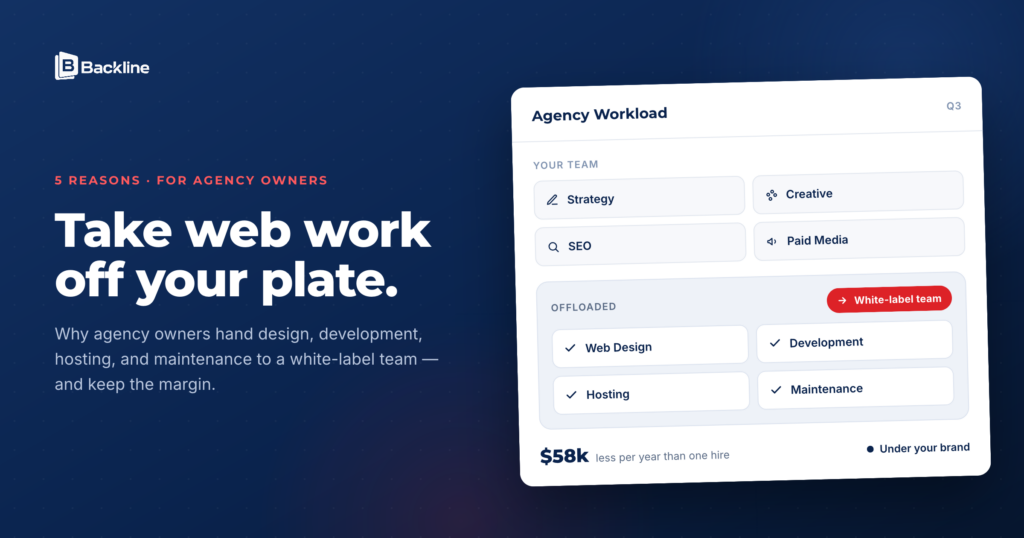
With white-label web development, an agency outsources web development to a specialized web agency who employs highly skilled developers, covers tech costs, and ships a higher quality site under the Agency of Record’s (AOR) brand name.
Costs
Costs range quite a bit for white-label web development. Individual projects can range from a few hours, to hundreds of hours for more complex builds. For agencies with more consistent web development needs, some white-label services offer monthly subscriptions that allow agencies to use their team as an extension of their own, covering design, development, testing, hosting, support, and more. Those can range from $1,000 to $5,000 or more per month, depending on the desired level of service.
Work Quality
White-label web development offers the best of both worlds: the consistency and scalability of an in-house team, for the lower, overhead-free cost of outsourcing.
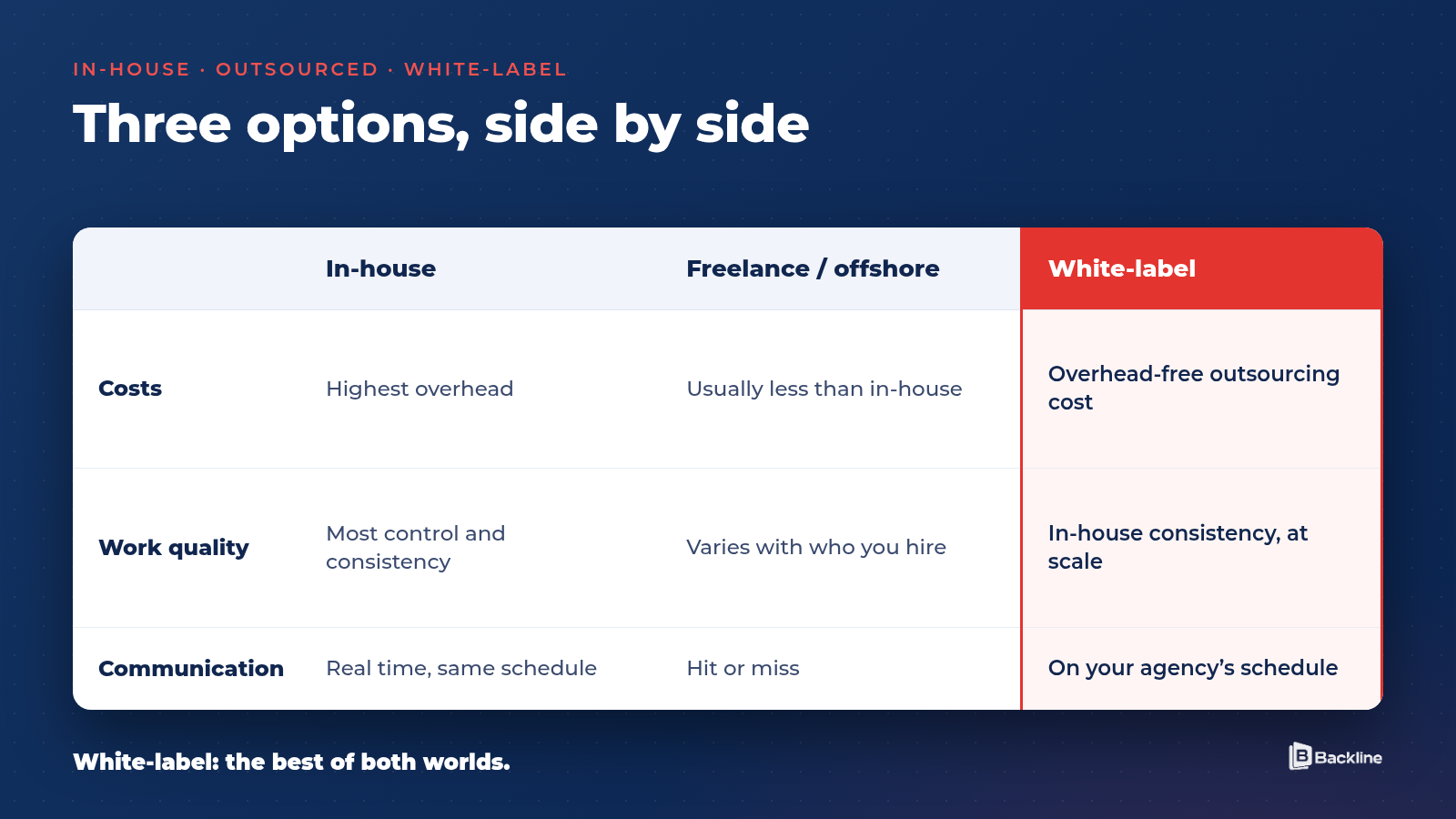
The beauty of a white-label web agency is that they have the room to focus on the craft of web development and design. While full-service marketing agencies must staff for the breadth of marketing services, white-label web development firms focus their hiring efforts on the best of the best developers, designers, and specialists. So the AOR gets a dedicated team of designers, developers, and project managers that are more skilled and more affordable.
Communication
White-label web development firms work on the marketing agency’s schedule—not the other way around. Especially with a dedicated monthly partnership, you can expect proactive, professional communication throughout the project, because they operate at an agency caliber.
Many marketing agencies want to maintain their brand image with clients and keep their outsourced workforce behind the curtain. White-label web development is ideal for these agencies: They do the work behind the scenes, funnel all communication through the AOR, and ship everything under the AOR’s name.
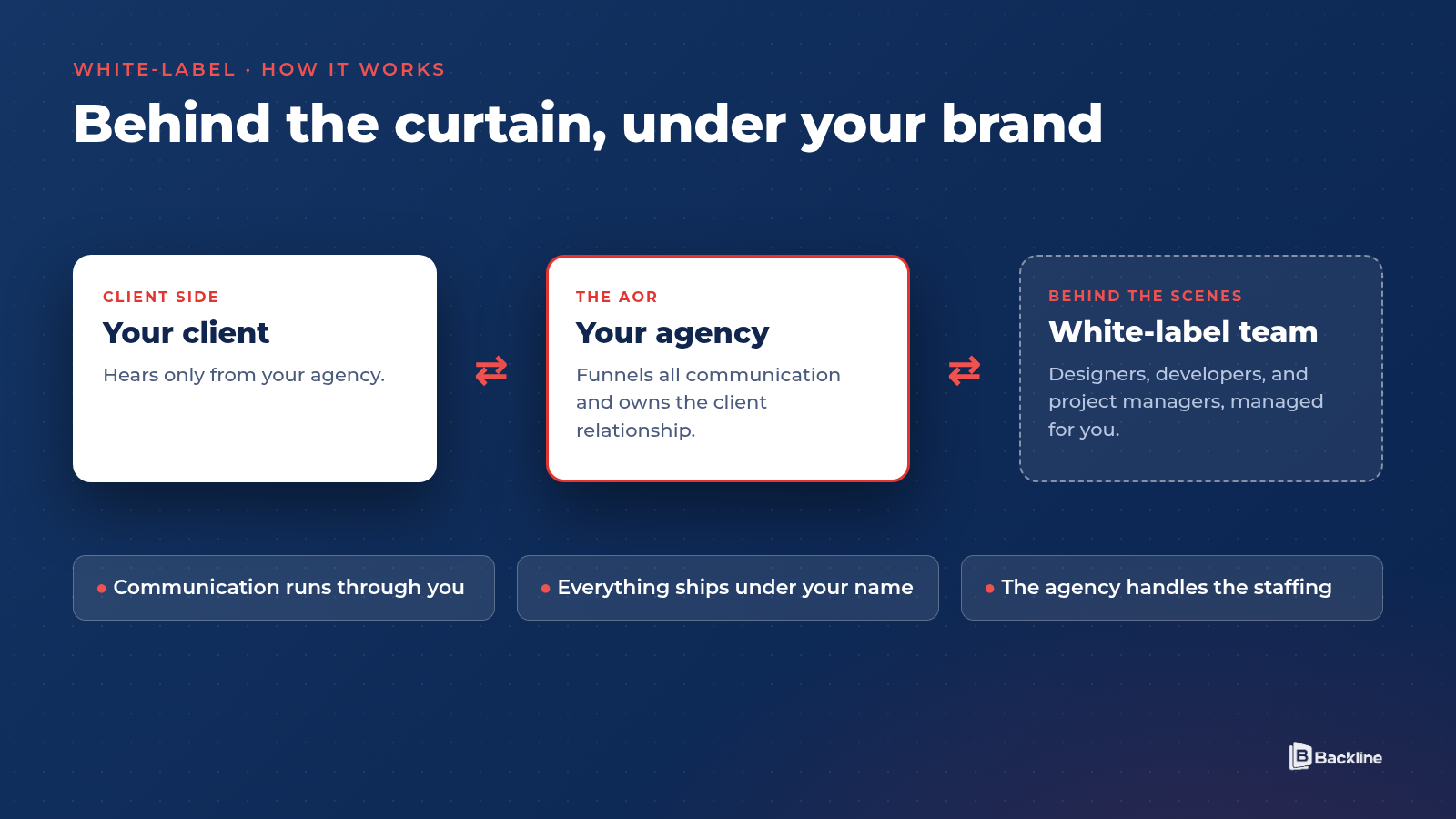
Best of all, the white-label agency manages the web team so the AOR doesn’t have to. If any issues arise with the web team, the white-label agency handles the staffing. No scrambling to replace a ghosted freelancer three weeks before a major site launch—just smooth sailing and consistent availability.
Try White-Label Web Development for Your Next Web Project
Curious about white-label web development in practice? Here at Backline, we offer month-to-month agreements without contracts, so you can test it in your workflow risk-free.
Starting at just $99 per month, our senior-level WordPress developers and designers fulfill whatever your clients need: custom features, Advanced Custom Fields, third-party integrations, WooCommerce, site fixes, database management, troubleshooting, and more. Professional communication. Best-in-class quality. For a price that keeps you profitable.
Tell us about your next project, and we’ll tell you how we can help.